

Streamlining Success: Basic Guide to Business Process Analysis
Business process analysis is the backbone of organizational efficiency, allowing companies to identify bottlenecks, eliminate waste, and optimize operations.

On this page
Business process analysis is the backbone of organizational efficiency, allowing companies to identify bottlenecks, eliminate waste, and optimize operations. Whether you’re looking to reduce costs, improve quality, or enhance customer satisfaction, mastering the fundamentals of business process analysis is crucial for sustainable business improvement.
Understanding Business Process Levels
Organizations operate with processes at multiple levels:
- Enterprise-level processes: These cross-functional workflows span the entire organization, like order-to-cash or product development lifecycles.
- Department-level processes: Confined to specific functional areas such as HR onboarding, accounting month-end closing, or marketing campaign execution.
- Project-level processes: Temporary workflows designed to achieve specific objectives within defined timelines.
- Task-level processes: Individual activities that make up larger processes, often performed by a single person or role.
Understanding these levels helps analysts target their efforts appropriately and recognize how changes at one level impact the broader organization.
The Business Process Analysis Framework
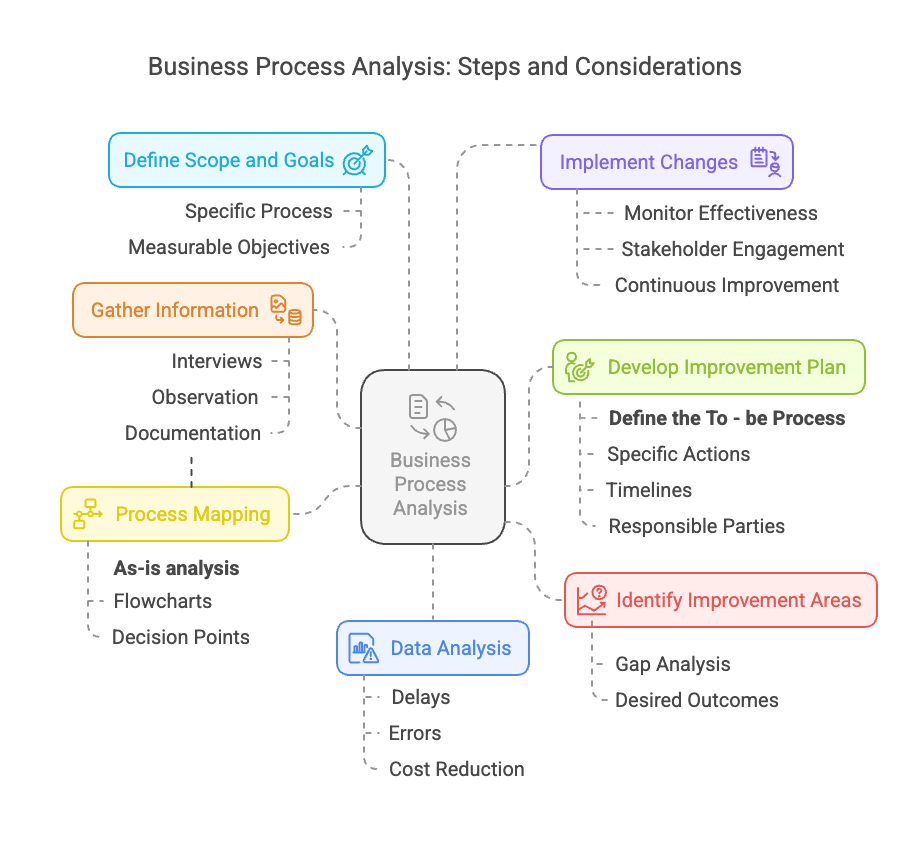
1. Define Scope and Goals
Start by clearly identifying which process needs analysis. Is it customer onboarding, procurement, or perhaps product delivery? Set specific, measurable objectives that align with business goals. For instance, rather than aiming to “improve efficiency,” target “reducing order processing time by 25%” or “decreasing error rates by 15%.”
2. Gather Information
Thorough data collection creates the foundation for meaningful analysis:
- Interviews: Speak with process participants to understand their experiences and challenges.
- Observation: Watch the process in action to identify informal workarounds and actual versus documented procedures.
- Documentation: Review existing process documentation, work instructions, and reports.
- Systems analysis: Examine how technology supports or hinders the process flow.
These information-gathering techniques, highlighted in the diagram, ensure that you capture both formal and informal aspects of the current process.
3. Process Mapping
Visualize the current state through detailed process maps that showcase:
- The step-by-step workflow (as-is analysis)
- Decision points and branching logic
- Handoffs between departments or individuals
- System interactions and data transfers
- Time requirements for each activity
Process maps transform abstract workflows into tangible diagrams that make inefficiencies immediately apparent.
4. Data Analysis
Move beyond subjective opinions by quantifying process performance:
- Measure cycle times and identify delays
- Calculate error rates and quality issues
- Evaluate resource utilization and bottlenecks
- Analyze costs associated with each process step
- Identify variation in performance metrics
This quantitative approach provides objective evidence of problem areas and reveals hidden issues that qualitative analysis might miss.
5. Identify Improvement Areas
With data in hand, pinpoint opportunities for enhancement through:
- Gap analysis: Compare current performance against industry benchmarks or internal targets.
- Root cause analysis: Dig beyond symptoms to understand underlying issues.
- Value stream mapping: Distinguish between value-adding and non-value-adding activities.
6. Develop an Improvement Plan
Transform insights into action with a comprehensive plan that includes:
- Clearly defined “to-be” process designs
- Specific action items for implementation
- Realistic timelines and milestones
- Assigned responsibilities
- Resource requirements
- Change management considerations
7. Implement Changes
Execute your plan while maintaining clear communication with stakeholders. Consider piloting changes in controlled environments before full-scale implementation.
8. Monitor Effectiveness
Establish mechanisms to track performance against baseline measurements. Be prepared to make adjustments based on feedback and results.
Key Considerations for Success
- Stakeholder engagement: Involve key participants early and often to ensure buy-in and practical solutions.
- Technology enablement: Leverage business process modeling software and data analytics tools to enhance analysis capabilities.
- Continuous improvement mindset: View process analysis as an ongoing journey rather than a one-time project.
- Cultural sensitivity: Recognize that process changes impact people’s daily work—address resistance with empathy and clear communication.
- Balance analysis with action: Avoid analysis paralysis by setting clear timeframes for moving from investigation to implementation.
The Bottom Line
Business process analysis isn’t merely about identifying problems—it’s about creating sustainable solutions that align with strategic objectives. By methodically working through these steps and considering the various levels at which processes operate, organizations can achieve meaningful improvements that enhance customer satisfaction, employee experience, and financial performance.
When done right, business process analysis becomes a powerful competitive advantage, enabling organizations to adapt quickly to changing market conditions while maintaining operational excellence.
Updated February 28, 2025
Continue exploring
Ideas worth thinking about.
Occasional notes on AI, digital transformation, product strategy and building useful technology.