

Enterprise Architecture as a Living Decision System
A practical model for turning enterprise architecture from a diagram repository into a living decision system connecting strategy, capabilities, data, controls and investment.
On this page
When a regulatory inquiry, a major security breach, or an AI hallucination hits the headlines, the standard corporate response is procurement: buy a governance platform, generate compliance reports, and declare the enterprise safe. But monitoring a problem is not the same as solving it.
If your organization cannot trace an autonomous AI decision back to its source data, system owner, and strategic intent, you don’t have an architecture—you have an Architecture Gap.
Many organizations claim to have Enterprise Architecture (EA) because they own an expensive repository tool, publish standards, and maintain pristine diagrams. But when an urgent strategic question arrives:
- Can we introduce a generative AI assistant into this customer workflow?
- Which core capabilities would be compromised if we retire our legacy core platform to fund digital transformation?
- What customer, regulatory, data, and financial consequences follow from this vendor migration?
- Which transformation initiative should receive priority funding?
The organization has a museum of artifacts, but cannot assemble a timely, defensible answer.
That is the difference between architecture as a passive repository and architecture as a living decision system. A living decision system doesn’t attempt to document every detail at maximum granularity. It maintains the minimum viable set of traceable relationships required to make, execute, monitor, and adapt critical enterprise decisions at speed.
Why the Boardroom Conversation Has Shifted
The macro landscape has changed permanently:
- The Regulatory Landscape: The European Union began enforcing key provisions of the EU AI Act, while NIST released draft guidance on public-facing AI documentation. Enterprise leaders face strict runtime compliance and audit requirements.
- The Agentic Paradigm: As organizations transition from experimental chatbots to autonomous, agentic AI workflows, business data moves and acts independently. Policies written on paper offer zero protection; governance must be machine-enforced at runtime.
- Ecosystem Agility: At The Open Group Quito Event, industry leaders connected frameworks like TOGAF, ArchiMate, Open Agile Architecture, and IT4IT directly to digital ecosystem agility and executive decision-making.
Architecture can no longer focus solely on a static future-state technology picture. It must serve as the dynamic bridge connecting enterprise strategy, business products, data flows, controls, and real-time operating evidence.
The failure pattern: architecture after the decision
Architecture becomes ceremonial overhead when:
- Governance is illusory: Platforms monitor violations, but the underlying operational model (data ownership, decision boundaries) remains broken.
- Views are built for boards, not decisions: Teams create diagrams solely to clear approval gates, then immediately discard them.
- Updates are post-hoc: The architecture repository is updated weeks after software has deployed to production.
- Roadmaps compete for authority: Product roadmaps, technology modernization roadmaps, and business strategies operate in isolated silos.
- Exceptions are permanent: Architecture exceptions are granted under pressure but never tracked or expired.
In this environment, architects become curators of historical intent—acting as corporate historians rather than strategic decision-makers. Delivery teams bypass EA to stay fast, while the C-suite views EA as an expensive bottleneck.
The cure is not a larger metamodel.
It is a sharper decision spine.
Build the enterprise decision spine
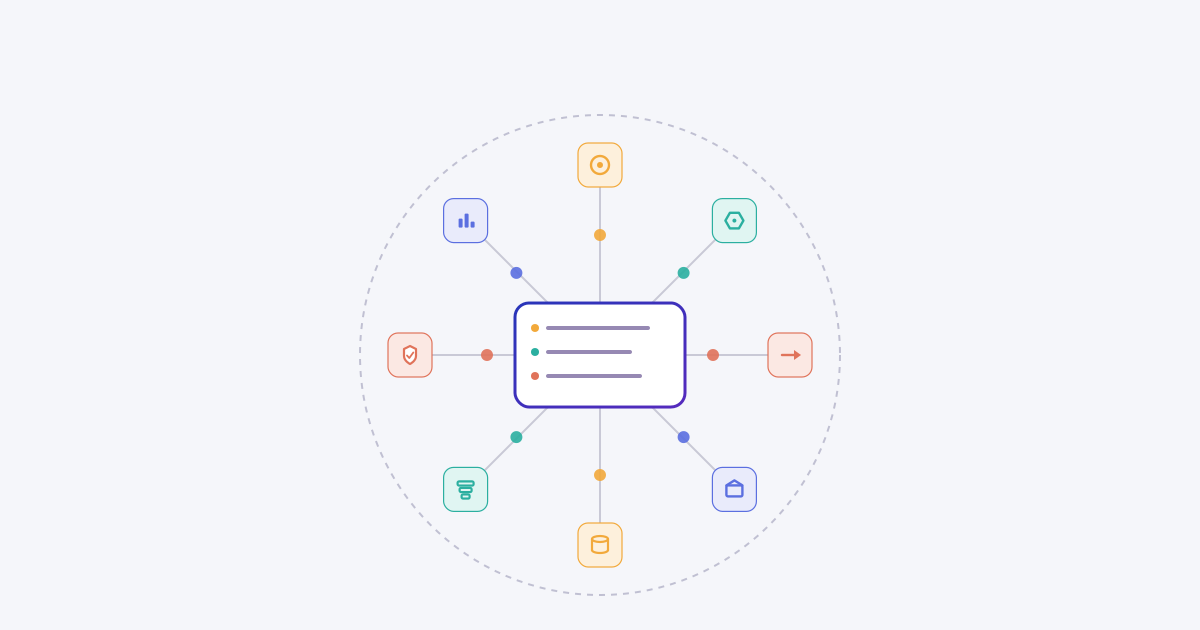
The decision spine is a connected set of enterprise facts that lets teams trace change from purpose to result.
At minimum, connect:
- Strategic outcomes: What measurable change is the organization pursuing?
- Capabilities: What must the enterprise be able to do well?
- Value streams and processes: How is value created, and where does work move?
- Products and services: What do customers and users experience?
- Information and data: What knowledge and records make the capability work?
- Applications, platforms, and technology: What enables, constrains, or duplicates the capability?
- Controls and obligations: What must remain true for the design to be responsible and acceptable?
- Initiatives and investments: What change is funded, sequenced, owned, or stopped?
- Measures and evidence: What proves the architecture is delivering the intended outcome?
Using open modeling standards like ArchiMate (see ArchiMate 101 Practical Introduction), the value lies in generating tailored views from a single, coherent underlying model:
- The CEO / Board: Requires a capability heat map mapped against strategy and capital allocation.
- Engineering Teams: Require runtime principles, API contracts, and transition architectures.
- The CISO / Risk Officer: Requires data lineage, trust boundaries, and regulatory enforcement points.
- The Product Leader: Requires value stream impacts, dependencies, and customer experience metrics.
The 6 Core Decision Products (Replacing the Diagram Graveyard)
Instead of maintaining hundreds of unused diagrams, high-performing EA practices maintain six active decision products:
1. Outcome-Linked Capability Map
- Purpose: Heat-map capabilities by strategic importance, operational fatigue, technical debt, and duplicate spending.
- Executive Choice: Where to concentrate capital, what to standardize vs. differentiate, and which capabilities constrain strategy.
2. Value-Stream & Experience Map
- Purpose: Trace capabilities to critical customer and employee touchpoints.
- Executive Choice: Identify where friction causes customer churn, where human judgment is mandatory, and where AI automation yields high ROI.
3. Application, Data & Dependency Graph
- Purpose: Visualize application interdependencies, authoritative data sources, and single-point-of-failure risks.
- Executive Choice: Decide platform retirements, software consolidation, integration patterns, and vendor risk exposure.
4. Executable Principles & Guardrails
- Purpose: Establish guardrails with explicit trade-offs and exception rules.
- Example 1: Prefer reusable data products over project-specific copies.
- Example 2: Require source traceability for AI-generated summaries used in clinical or financial decisions.
- Example 3: Autonomous AI agents cannot execute irreversible financial or legal actions without human approval.
- Executive Choice: Accelerate decentralized team choices while enforcing enterprise-wide compliance.
5. Architecture Decision Log (ADL)
- Purpose: Document choices, alternatives considered, assumptions, tradeoffs, owners, and review triggers with expiration dates.
- Executive Choice: Prevent constant relitigation of past decisions when market conditions change.
6. Technical Debt & Transition Portfolio
- Purpose: Frame technical debt as a portfolio of risk-weighted business choices rather than developer complaints.
- Executive Choice: Sequence work packages to balance innovation speed with platform health.
Sources and further reading
- The Open Group: AI, Open Standards and Sustainable Transformation, 27–29 July 2026
- The Open Group: TOGAF Standard
- The Open Group: ArchiMate overview
- The Open Group: ArchiMate 101 practical introduction, May 2026
- NIST AI Standards: public-facing AI documentation draft, 29 July 2026
- European Commission: AI Act enforcement update, 31 July 2026
Related reading: Streamlining Success: Basic Guide to Business Process Analysis
Updated August 6, 2026
Continue exploring
Ideas worth thinking about.
Occasional notes on AI, digital transformation, product strategy and building useful technology.