

Your AI Policy Is Not Your AI Inventory
Shadow AI is often a symptom of workflow friction. This guide shows leaders and business analysts how to find unofficial AI use, classify consequence, and turn unmet demand into governed improvement.

On this page
“I just paste it into the other tool because it gives me the answer faster.”
That is the most revealing sentence in any AI discovery workshop — and it is rarely technical. A team member is summarizing vendor proposals, analyzing meeting notes, or drafting code. The intention is reasonable; the efficiency is real. The risk is that leadership has zero visibility into the workflow.
This is Shadow AI: AI tools, browser extensions, SaaS features, low-code agents, or API scripts used for business operations without visibility, approval, or governance.
Having an AI policy without an AI inventory does not reduce risk — it creates a Policy-Practice Gap. In a regulatory audit or data incident investigation, an ignored policy simply proves that leadership recognized the risk but failed to enforce controls.
Why tool surveys fail
When organizations attempt to catalog AI, they usually send a questionnaire: “Which AI tools do you use?” This approach produces an incomplete list and tells you nothing about business consequence.
- Tool surveys miss embedded features. Employees don’t view an AI feature inside an existing SaaS app as a “new tool.”
- Tool surveys ignore context. A writing assistant used for a generic presentation is low-risk; the same tool used to summarize confidential grievances is high-risk.
The atomic unit of AI discovery is not the software tool — it is the task inside the workflow.
A 6-step workflow method for discovering Shadow AI
An unmet business need creates workflow friction. Workflow friction produces a Shadow AI workaround. This method turns that workaround into visible, governed practice — through triage by consequence and a fast, safe lane for legitimate use.
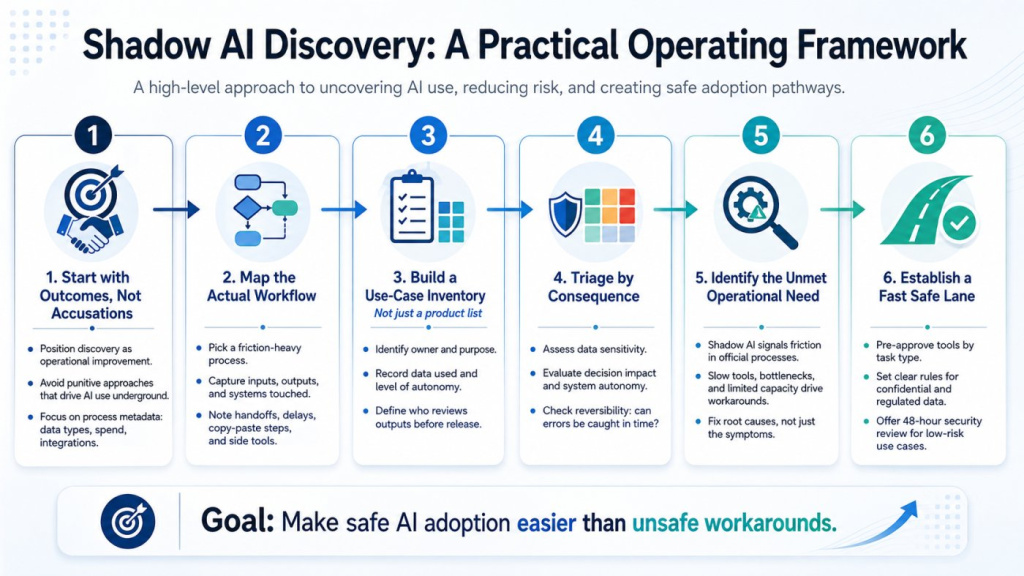
1. Start with outcomes, not accusations
Treat discovery as operational improvement, not an investigation. If employees fear punishment, usage goes deeper underground. Collect process-level metadata — data categories, spend, and integrations — rather than inspecting individual prompts.
2. Map the actual workflow
Select a friction-heavy process (e.g., vendor evaluation, candidate screening, monthly reporting). Map what actually happens: inputs, outputs, and systems touched; manual handoffs, delays, and informal copy-paste steps; personal accounts, browser extensions, and team scripts.
3. Build a use-case inventory, not a product list
One AI product can support ten workflows with ten distinct risk profiles. Record the owner and purpose (who uses it and what problem it solves), the data and autonomy involved (what data feeds it, and whether the system drafts, recommends, or acts autonomously), and the human oversight in place (who verifies the output before it leaves the organization).
4. Triage by consequence
Classify each use case across four dimensions:
- Data sensitivity — public, internal, confidential, or strictly regulated?
- Decision impact — does it affect finance, legal rights, employment, or safety?
- System autonomy — does it generate drafts or autonomously trigger actions?
- Reversibility — can a human detect and correct an error before harm occurs?
5. Identify the unmet operational need
Shadow AI is an indicator of operational friction. It signals that approved software is too slow, access requests are bottlenecked, or official capacity is insufficient. Address the root cause, or the behavior will persist under a new name.
6. Establish a fast “safe lane”
Bans drive usage invisible. Build a safe lane that includes pre-approved tools mapped to common task types, clear input rules for confidential and regulated data, and accelerated 48-hour security reviews for low-risk use cases.
The 90-minute workflow workshop
Execute this structure with one operational unit at a time:
| Time | Focus | Objective |
|---|---|---|
| 15 min | Scope | Select one high-friction business process. |
| 20 min | Map steps | Document actual steps, delays, and manual handoffs. |
| 15 min | Identify touchpoints | Highlight every AI feature, personal account, and automation. |
| 20 min | Evaluate consequence | Classify data sensitivity, decision impact, and oversight points. |
| 20 min | Action & lane | Approve for safe lane, redesign, or retire. |
Key metrics for executive dashboards
Stop measuring success by the number of blocked domains. Measure operational health instead:
- Inventory coverage — % of core business workflows with mapped AI touchpoints.
- Time-to-approval — average hours from use-case request to safe-lane access.
- High-impact oversight — % of consequential AI outputs receiving mandatory human review.
- Retired redundancy — duplicate or unmanaged AI subscriptions eliminated.
Strategic summary
Shadow AI is not solely a security gap — it is a signal showing where enterprise demand is outstripping legacy operating models.
Your policy states what should happen.
Your workflow inventory reveals what actually happens.
Governance begins when those two pictures meet.
Sources and further reading
- European Commission: EU AI Act enforcement & transparency rules, 2 August 2026
- NIST: AI Risk Management Framework (AI RMF)
- NIST: Generative AI Profile (NIST AI 600-1)
- NCSC UK: Managing Shadow IT Guidance
- OWASP: Top 10 for Agentic AI Applications
Related reading: Streamlining Success: A Basic Guide to Business Process Analysis · Beyond Compliance: How Accessible Websites Drive Business Growth
Updated August 6, 2026
Continue exploring
Ideas worth thinking about.
Occasional notes on AI, digital transformation, product strategy and building useful technology.