

Beyond Compliance: How Accessible Websites Drive Business Growth
Providing equal access to digital content and creating inclusive user experiences for all people is the online equivalent of building wheelchair ramps for physical stores.

On this page
- Introduction
- Unlocking Digital Accessibility for a Trillion-Dollar Market
- Understanding the POUR Principles of Accessibility
- The Business Case for Web Accessibility: ROI Beyond Legal Compliance
- The Cost of Inaccessibility: Why Prevention Beats Remediation Every Time
- Accessibility: The Brand Reputation Booster You Didn’t Know You Needed
- Future-Proofing Your Business with Accessibility
Providing equal access to digital content and creating inclusive user experiences for all people is the online equivalent of building wheelchair ramps for physical stores. Just as brick-and-mortar businesses recognize the importance of physical accommodations, digital spaces demand their own form of accessibility. Ensuring everyone can navigate and engage with your digital content isn’t just a matter of compliance—it’s about creating a welcoming and equitable space for all.
Yes, web accessibility is often discussed in terms of legal obligations—hitting those WCAG benchmarks, steering clear of potential lawsuits, and staying compliant. But accessibility isn’t just about ticking boxes and staying within legal boundaries; the goal goes beyond mere compliance. It’s a powerful driver of business growth, customer loyalty, and brand reputation and an opportunity to unlock new markets.
In this post, we’ll explore why accessibility matters beyond compliance, the ROI of investing in accessibility, and quick fixes you can implement today to future-proof your website.
Unlocking Digital Accessibility for a Trillion-Dollar Market
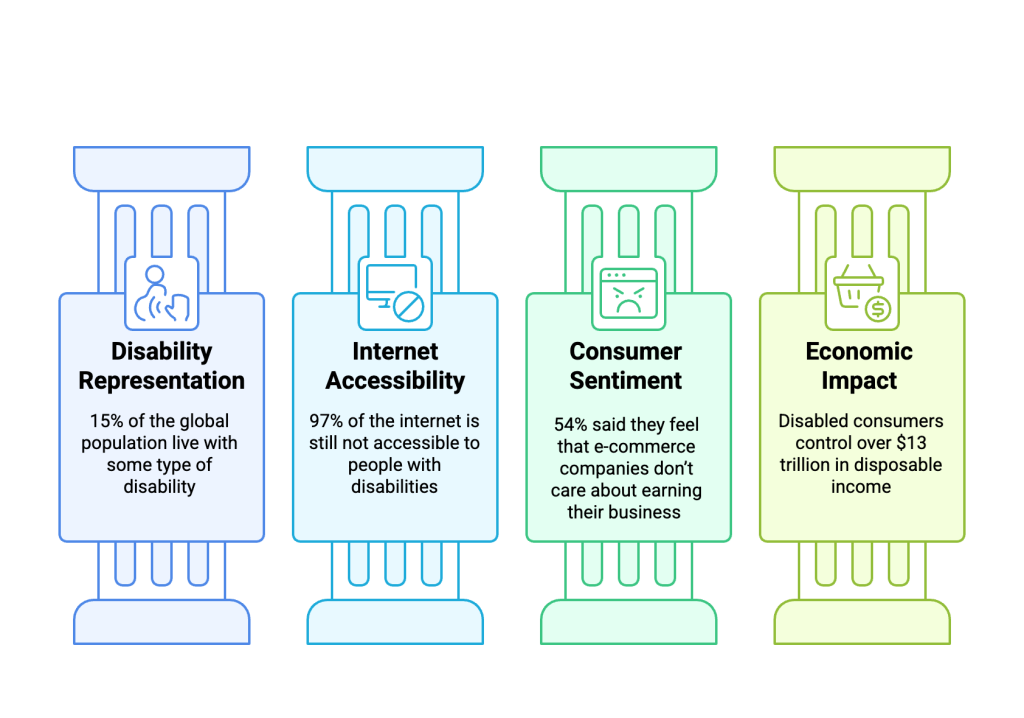
Understanding the POUR Principles of Accessibility
The Web Content Accessibility Guidelines (WCAG) represent a set of internationally recognized standards designed to assist content creators and developers in producing web content—including websites, web applications, and other digital platforms—with a focus on accessibility.
The framework of WCAG is anchored by four core principles, encapsulated in the acronym POUR: Perceivable, Operable, Understandable, and Robust. This model provides a structured approach to web accessibility, facilitating a comprehensive analysis of how content can be made accessible.

- Perceivable: Information and user interface components must be presented in ways that users can perceive. This includes providing text alternatives for non-text content, ensuring adaptable layouts, and enabling users to differentiate between various elements.
- Operable: User interface components must be operable. Users should be able to navigate and interact with all interface elements without requiring actions that are difficult to perform. This includes ensuring that all functionality is accessible via keyboard and providing sufficient time for users to read and use content.
- Understandable: Content and operation of the user interface must be understandable. This means that information should be clear and concise, and that the interface should operate in predictable ways.
- Robust: Content must be robust enough to be reliably interpreted by a wide variety of user agents, including assistive technologies. This involves using valid HTML and ensuring compatibility with current and future technologies.
Exploring these principles in detail provides a solid foundation for implementing effective accessibility practices in web development.
The Business Case for Web Accessibility: ROI Beyond Legal Compliance
Did you know? People with disabilities represent a market segment with $1.2 trillion in annual disposable income globally. Yet, many businesses unintentionally lock out this massive segment with inaccessible websites and digital experiences. When your competitors haven’t prioritized accessibility, implementing inclusive design isn’t just the right thing to do—it’s an untapped competitive advantage that can significantly expand your market reach.
Consider this: 71% of users with disabilities will immediately leave a website that isn’t accessible. By contrast, when these same users find an accessible site, their brand loyalty rates exceed those of the general population by nearly 30%. A recent survey found that 62% of consumers are more likely to purchase from brands that take visible stands on social issues, including digital inclusion.
Ignoring accessibility means shutting out millions of potential customers. Businesses that prioritize accessibility gain significant competitive advantages.
The Cost of Inaccessibility: Why Prevention Beats Remediation Every Time
Many companies only think about accessibility after receiving a legal complaint. However, retrofitting an inaccessible website is far more expensive than building accessibility into your digital strategy from the start. The financial argument for proactive accessibility is compelling:
- Lawsuits & Settlements: Legal battles can cost hundreds of thousands in legal fees and penalties. Legal settlements for inaccessible websites average $25,000-$150,000 per case.
- Lost Revenue: Users who can’t navigate your website will simply take their business elsewhere.
- Brand Damage: Accessibility lawsuits and negative PR can severely impact public perception.
- Development Costs: Fixing accessibility issues post-launch is often 5x more expensive than incorporating them during development. Implementing accessibility during initial development adds approximately just 1-3% to project costs.
Beyond these direct costs, inaccessible sites suffer opportunity costs in lost revenue, diminished SEO performance, and brand damage that can far exceed the investment required for compliance. A simple accessibility audit can reveal hidden issues that may be costing your business potential customers.
Accessibility: The Brand Reputation Booster You Didn’t Know You Needed
Emerging technologies like voice interfaces, artificial intelligence, and augmented reality are creating both challenges and opportunities for inclusive design. These advancements necessitate a reevaluation of design principles to ensure accessibility and usability for diverse user populations, while also offering innovative solutions to enhance interaction and engagement across different demographics.
Organizations that build accessibility into their digital DNA now are better positioned to:
- Adapt quickly to evolving legal requirements
- Leverage emerging technologies more effectively
- Appeal to the growing demographic of aging consumers
- Meet the expectations of younger, more socially conscious audiences
- Create innovation advantages through inclusive design thinking
Future-Proofing Your Business with Accessibility
Accessibility isn’t just about today—it’s about preparing for the future. As AI-driven interfaces, voice search, and augmented reality evolve, accessible design principles will become essential for emerging technologies. Companies that invest in accessibility now will be better positioned for future innovations and regulatory changes.
- AI & Voice Search: Accessible websites are more structured, making them easier for AI-driven search engines to understand.
- Wearable & Assistive Tech: More users are relying on devices like screen readers, voice-controlled assistants, and AR overlays.
- Regulatory Evolution: Laws are becoming stricter worldwide—staying ahead of compliance today prevents future risks.
Making accessibility a core business strategy today ensures sustainability and resilience tomorrow.
Web accessibility is not just a compliance checkbox—it’s a strategic business advantage that improves SEO, user experience, market reach, brand reputation, and long-term sustainability. Companies that prioritize accessibility don’t just avoid risks; they gain a loyal customer base and a competitive edge.
The question isn’t “Can we afford to make our website accessible?”—it’s “Can we afford not to?”
Updated March 1, 2025
Continue exploring
Ideas worth thinking about.
Occasional notes on AI, digital transformation, product strategy and building useful technology.