

Who Actually Owns Your AI Risk?
Ownership is usually undefined until something breaks — and by then it’s a legal question, not a governance one.
On this page
The idea in 30 seconds
- The person who approves an AI tool is usually the same person held accountable when it fails — a structural conflict most organizations never name out loud.
- Board sign-off on an AI budget is not the same as board ownership of AI risk, and most boards are quietly aware of the gap.
- Closing the gap doesn’t require a new committee — it requires a named, individual owner for each risk domain before the pilot starts, not after.
Ask five people at a mid-size company who owns the risk on the AI tool the sales team quietly rolled out last quarter, and you’ll get five different, confident, wrong answers. IT will say it’s the business unit’s tool, so it’s the business unit’s risk. The business unit will say IT approved the vendor, so it’s IT’s risk. Legal will say they were never looped in, so it isn’t theirs yet. The CIO will say the board signed off on the AI budget, so ownership sits above their desk. Everyone is describing a decision they didn’t make.
That’s not a fluke of one busy quarter. It’s the default state of AI governance at most organizations right now — and it holds, quietly, until the first real incident forces someone to answer for it.
Not legal advice. This article describes an organizational-design pattern for AI risk ownership. It is not legal advice and should not be relied on as a substitute for advice from a qualified lawyer about your organization’s specific compliance, liability, or regulatory exposure.
The structural flaw no one names
Most organizations route AI purchasing and adoption decisions through a single role. According to Schellman’s 2026 State of AI Governance Report, based on a survey of 525 U.S. enterprise leaders, 42% of organizations give that authority to the CIO or head of IT alone, 16% to a Chief Data Officer or AI Officer, and 10% to the CEO. On paper, that reads as clear ownership. In practice, it’s one desk carrying two jobs that pull in opposite directions: the person who decides to bring a tool in is usually the same person left explaining it afterward, whether the failure shows up as a compliance gap, a security incident, or an angry customer.
Definition
Decision ownership and risk ownership are not the same job. The person best positioned to judge whether a tool solves a business problem quickly is rarely the person best positioned to judge its compliance, security, or reputational exposure. Put both jobs on one desk, and the second job gets whatever attention is left over.
42%
of organizations hand AI purchasing authority to a single role, usually the CIO or head of IT, and that same role is the one held accountable when the tool goes wrong. (Schellman, 2026 State of AI Governance Report, n=525)
Boards are approving budgets, not owning risk
The gap doesn’t close at the board level — it just changes shape. Grant Thornton’s 2026 AI Impact Survey, based on nearly 1,000 senior U.S. business leaders, found that 75% of boards have approved a major AI investment, but only 52% have translated that into clear governance expectations, and just 54% have made AI risk a standing part of board or committee oversight. And when pressed on how confident they actually are, 78% admit they couldn’t guarantee their organization would survive an independent AI governance audit with only 90 days’ notice.
That’s not a technology gap. It’s an ownership gap, dressed up as a budget line. A board can approve millions in AI spend in the same meeting where AI risk oversight never becomes its own agenda item — and at nearly half the companies surveyed, that’s exactly what happened.
A board can approve the AI budget and still never own the AI risk. Those are two different votes — and most companies only take one of them.
Where the gap actually breaks
This isn’t theoretical. It shows up first as shadow AI, the pattern already covered on this site in Your AI Policy Is Not Your AI Inventory, because when ownership is unclear, the path of least resistance is not to ask. The Purple Book Community’s State of AI Risk Management 2026 study, surveying more than 650 senior security leaders across North America and Europe, found that 59% of organizations confirm or suspect shadow AI activity inside their own walls, and 73% say AI-assisted development is now outpacing their capacity to review it for security risk. Ownership doesn’t fail loudly. It fails when nobody is the person who was supposed to notice.
The fix isn’t a committee. It’s a Decision Spine.
The instinct, once this gap gets named out loud, is to stand up an AI governance committee. That’s usually the wrong first move — a committee is a meeting, not an owner. What actually closes the gap is naming, in writing, who is accountable for each distinct kind of AI risk before the first pilot starts, not after the first incident. That’s the same discipline behind the Decision Spine Framework already published on this site: separate who recommends, who decides, and who is accountable for the outcome, instead of letting “the team” or “leadership” quietly absorb all three at once.
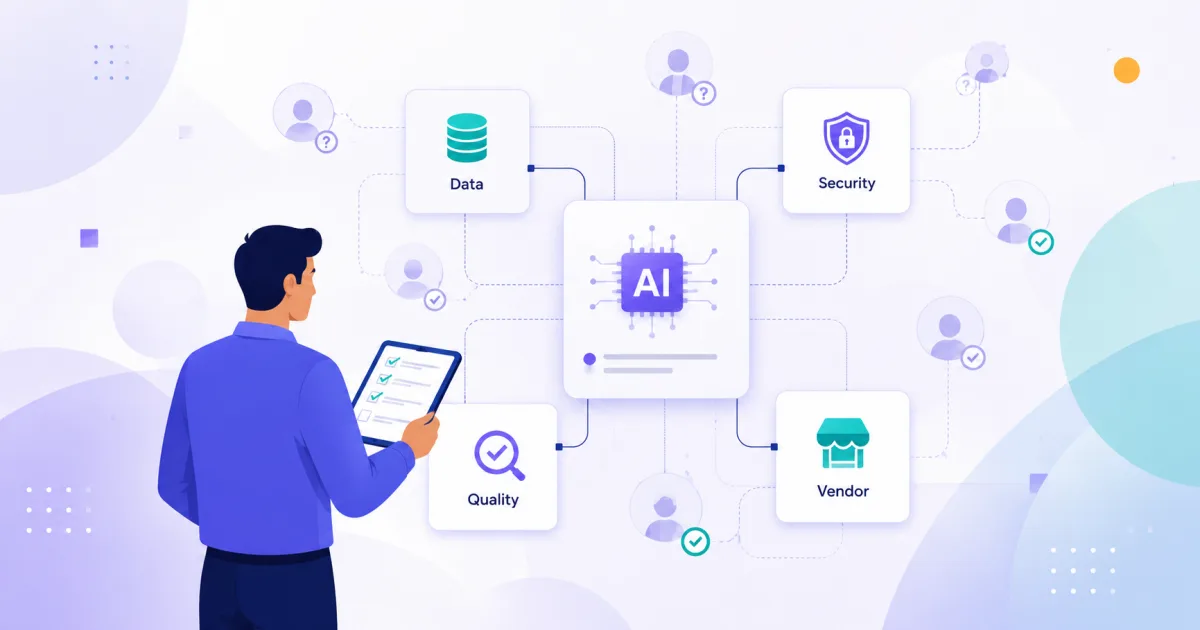
In practice, that means naming an owner for at least four distinct risk domains, before you need one:
- Data and privacy exposure — usually legal or a data protection lead
- Security and access — usually IT or security
- Decision quality and bias — usually the business owner closest to the outcome
- Vendor and continuity risk — usually procurement or the CIO’s office
Try this
Before your next AI pilot gets approved, put these four risk domains on one page next to the pilot’s name, and write down a specific person’s name, not a department’s, next to each one. If you can’t fill in a name, that’s the actual finding. Route the pilot back until you can.
Key takeaways
- The role that approves an AI tool and the role accountable for its failures are usually the same desk — a structural design flaw, not a personnel problem.
- Board approval of an AI budget is not the same vote as board ownership of AI risk; most boards are taking the first vote and skipping the second.
- Ownership gaps don’t announce themselves — they show up first as shadow AI, because unclear ownership makes it easier not to ask.
- Fixing this doesn’t require a new committee. It requires a named, individual owner for each risk domain (data/privacy, security, decision quality, vendor/continuity) before the pilot starts.
Sources & further reading
- Schellman, “Who Should Own AI Governance?” — 2026 State of AI Governance Report
- Grant Thornton, 2026 AI Impact Survey — “A widening ‘AI proof gap’ is emerging” (April 2026)
- The Purple Book Community, State of AI Risk Management 2026 (March 2026)
- On this site: The Decision Spine Framework
- On this site: Your AI Policy Is Not Your AI Inventory
Continue exploring
Ideas worth thinking about.
Occasional notes on AI, digital transformation, product strategy and building useful technology.