

Your AI Transformation Is Stuck Because Nobody Wants to Kill the Old Process
Most AI transformations don't stall on technology. They stall because leadership never officially retires the old process, leaving both running in parallel indefinitely.

On this page
Most AI transformations don’t stall because the technology fails. They stall because nobody with the authority to do it is willing to say: stop doing it the old way.
That’s an uncomfortable sentence for a lot of leadership teams, because it doesn’t sound like a technology problem. It sounds like a management problem. And it is.
The pattern shows up the same way almost every time
A team pilots an AI tool. It works — not perfectly, but well enough to prove the idea. Leadership is pleased. The tool gets rolled out more broadly.
And then the old process doesn’t go anywhere. The spreadsheet still gets updated by hand, “just in case.” The manual approval step stays in place, “for now.” The AI output gets double-checked against the way it used to be done, indefinitely, because nobody officially declared the old way over.
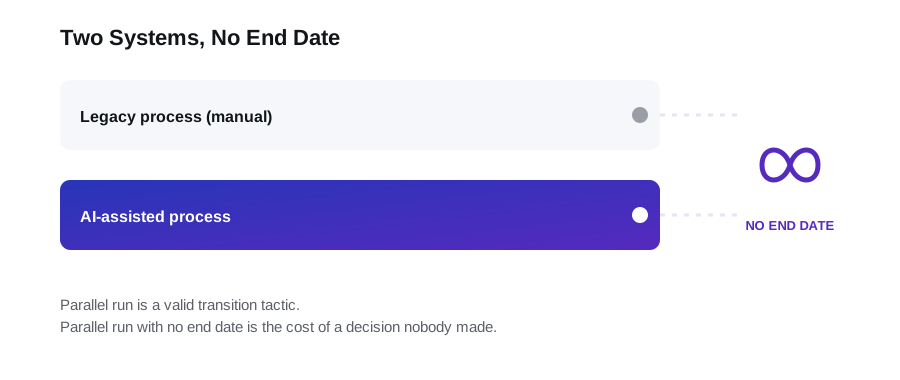
Six months later, the organization is running two systems in parallel — one AI-assisted, one legacy — and paying the overhead of both. That’s not a governance failure or a tooling failure. That’s a decision nobody made.
Why the decision doesn’t get made
Killing a process means killing a habit, and habits belong to people. The person who owns the old workflow usually built real expertise around its quirks — expertise that stops mattering the moment the process goes away. Nobody wants to be the one who tells them their judgment is no longer the bottleneck.
There’s also a quieter risk-aversion at work: keeping the old process “as backup” feels safe. It isn’t. It’s a standing admission that leadership doesn’t yet trust the new one — and every day it stays in place is a day the AI-assisted version never gets the chance to be trusted, because it’s never actually carrying full weight.
This is a Managed AI problem, not a Shadow AI problem
In the Governed Growth Model, this is what stalling inside the Managed AI stage looks like. Shadow AI is ungoverned experimentation. Governed AI-Native is when the new way of working is the only way of working, with the guardrails to match. Managed AI sits in between — and it’s possible to get comfortable there indefinitely, because it feels responsible. It isn’t. It’s just deferred.
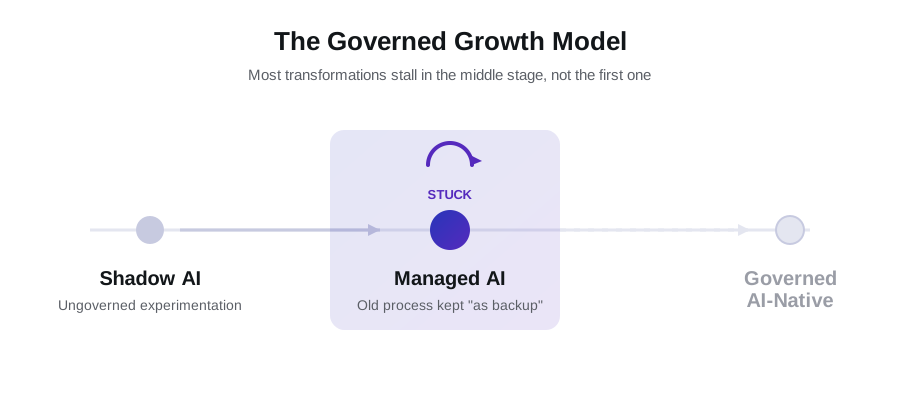
The organizations that get stuck aren’t the ones moving too fast. They’re the ones who mistake “we added AI to the workflow” for “we redesigned the workflow.” Those are different projects, and only one of them finishes.
What actually moves this forward
Retiring a process isn’t a technical decision — it’s a leadership one, and it needs a name and a date attached to it, not a vague intention. A few things that separate the organizations that get unstuck from the ones that don’t:
- Someone senior owns the sunset date. Not “eventually” — an actual date the old process stops being an acceptable answer.
- The old process’s expert gets a new job, not a demotion. Usually validating edge cases, training the system, or owning the exceptions the AI can’t yet handle.
- “Running both in parallel” gets a hard time limit. Parallel run is a legitimate transition tactic. Parallel run with no end date is just avoidance wearing a project plan.
- Leadership says the quiet part out loud. The team needs to hear, explicitly, that the old way is being retired — not infer it from a Slack message about a new tool.
None of this requires more AI capability. It requires someone willing to make a call that was always a management decision wearing a technology costume.
Continue exploring
Ideas worth thinking about.
Occasional notes on AI, digital transformation, product strategy and building useful technology.