

Compliance by Design: Connecting Innovation, Risk and Data Governance Before the Audit
Compliance by design turns obligations into testable product, data, architecture and operating requirements before late reviews make change expensive.

On this page
Compliance usually becomes expensive at the moment a team says, “We will document that before launch.”
By then, data pipelines are built, third-party vendors are contracted, user interfaces are finalized, and go-to-market dates are set. A late-stage review does not merely check work—it reopens decisions embedded deep within the product architecture.
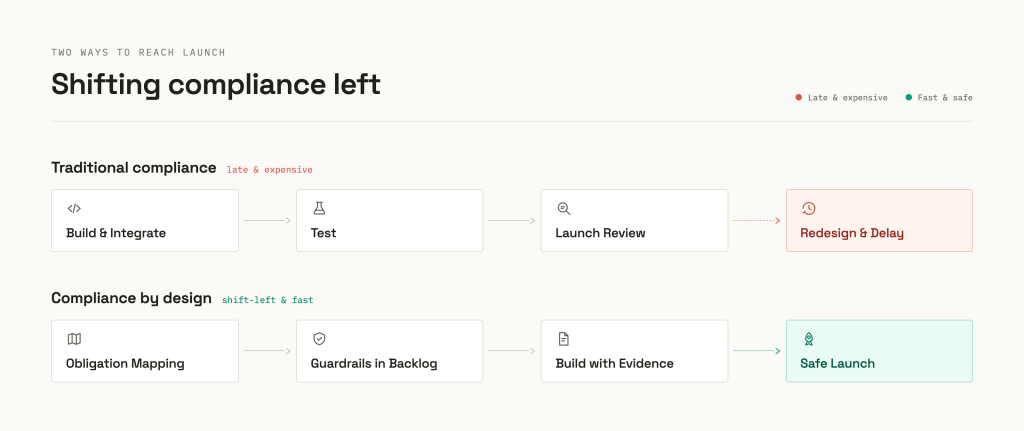
Compliance by Design is not a longer checklist at the end of delivery. It is the practice of translating every promise, risk, obligation, and control into testable product, data, and architecture requirements while changes are still cheap and simple to make.
The 5 Disciplines That Must Connect
Traditional organizations separate governance functions. High-performing enterprises unify them across the product lifecycle:
- Innovation: Defines the strategic value and business outcome to create.
- Product & Business Analysis: Translates the use case into user stories, decision logic, and acceptance criteria.
- Data Governance: Defines permitted data sources, purpose limitations, retention rules, and stewardship.
- Risk & Compliance: Maps regulatory obligations, affected rights, evidence standards, and risk tolerance.
- Architecture & Engineering: Implements durable, automated controls and logging across systems.
When connected, governance accelerates delivery. When disconnected, every project relitigates the same risk questions under deadline pressure.
Not legal advice. This article offers general operational guidance on building AI governance into delivery. It is not legal advice and should not be relied on as a substitute for advice from a qualified lawyer about your organization’s specific obligations under the EU AI Act, data protection law, sector rules, or any other regime.
The 2026 Regulatory Reality
The regulatory landscape has moved permanently from voluntary principles to active enforcement:
ISO/IEC 42001 & ICO Guidance: ISO/IEC 42001 and updated UK ICO Data Protection by Design guidelines reinforce that accountability, data lineage, and lifecycle evidence must be built into the organizational operating system.
EU AI Act Transparency (Article 50): The European Commission and national market authorities began enforcing Article 50 transparency obligations on August 2, 2026. Systems interacting with individuals, generating synthetic content, or deploying deepfakes now face mandatory disclosure, provenance signaling, and machine-readable markings.
NIST Post-Deployment Monitoring (AI 800-4): Published in March 2026, NIST AI 800-4 emphasizes that pre-launch testing is insufficient. AI systems behave dynamically in production, requiring continuous monitoring across functionality, security, human factors, and compliance.
NIST Public AI Documentation Draft: Released on July 29, 2026, NIST’s initial public draft provides standardized guidance and templates for public-facing AI documentation.
From Vague Obligations to Testable Requirements
High-level policy statements cannot be tested by QA teams. You must translate legal and ethical obligations into explicit system behaviors:
| Vague Policy Statement | Testable Product Requirement |
| “Protect user data privacy” | Explicitly restrict processing to 4 approved data fields; implement automated field redaction before model intake; set a strict 30-day retention purge on logs. |
| “Provide AI transparency” | Display an unambiguous UI disclosure on first load; embed machine-readable C2PA metadata into generated outputs; store user consent records. |
| “Maintain human oversight” | Require qualified human review for outputs with confidence scores under 85%; provide side-by-side source citations; log all manual overrides. |
| “Monitor model performance” | Track daily accuracy against human benchmarks; automatically alert the engineering lead if hallucination flags exceed 2% over a 24-hour window. |
| “Manage vendor AI risk” | Require zero-data-retention API contracts from model providers; mandate 30-day advance notice for model architecture updates. |
Risk Lanes: Accelerating Innovation Safely
Applying high-impact governance to a low-risk internal experiment creates friction. Treat governance dynamically through four operating lanes:
[ Incoming AI Initiative ]
│
├─► Lane 1: EXPLORE ──► Synthetic data | Time-limited sandbox | No external impact
├─► Lane 2: ASSIST ──► Human-in-the-loop | Approved tools | Drafts & retrieves
├─► Lane 3: ACT ──► Reversible action | Strictly bounded | Active logging & caps
└─► Lane 4: IMPACT ──► Consequential rights/finance | Rigorous legal & formal audit
- Lane 1 (Explore): Low-sensitivity data, isolated sandboxes, time-limited research. Fast-track setup with minimal friction.
- Lane 2 (Assist): AI drafts, extracts, or summarizes, but a qualified human reviews and approves every output before it takes effect.
- Lane 3 (Act within Bounds): System takes bounded, reversible operational actions (e.g., routing tickets, resetting low-level access) with strict transaction caps and immediate rollback rules.
- Lane 4 (High-Impact / Regulated): Materially impacts employment, credit, healthcare, safety, or legal rights. Requires formal legal review, rigorous bias/accuracy testing, and detailed audit trails.
The “Definition of Done” Checklist for AI Features
A feature is not ready for production merely because the code builds. It is Done when:
- [ ] Purpose & Scope: Business rationale, target audience, and explicit prohibited uses are documented.
- [ ] Data Lineage: Approved data inputs, permission rights, retention schedules, and masking steps are active.
- [ ] Human Control: The human reviewer has the necessary context, time, and explicit system mechanics to challenge or override outputs.
- [ ] Transparency: Disclosures comply with EU AI Act Article 50 and NIST standards, displaying context-appropriate UI notifications.
- [ ] Monitoring & Triggering: Automated alerts are configured for quality drift, security anomalies, and model/vendor changes.
- [ ] Rollback Plan: Immediate kill-switch or fallback to manual/deterministic workflows is operational.
The 30-Day Execution Playbook
- Week 1 (Design Brief): Select one upcoming or live AI use case. Draft a 1-page design brief detailing business outcomes, data flows, and risk boundaries.
- Week 2 (Requirement Mapping): Convene product, business analysis, engineering, risk, legal, and accessibility leads to translate obligations into user story acceptance criteria.
- Week 3 (Single Evidence Thread): Link repository records, data permissions, test cases, user disclosures, and logging specs into one connected traceability thread.
- Week 4 (Pattern Standardization): Convert learnings into reusable backlog templates, pre-approved risk lanes, and compliance “Definition of Done” criteria for future builds.
Strategic Summary
The ultimate test of enterprise governance is not whether a system passed a launch review. It is whether leadership will know when the assumptions behind that approval are no longer true.
Models update, data shifts, user behaviors evolve, and regulations expand. Compliance by Design ensures your innovations are built on transparent, monitored, and defensible foundations—making enterprise growth both fast and durable.
Updated August 7, 2026
Continue exploring
Ideas worth thinking about.
Occasional notes on AI, digital transformation, product strategy and building useful technology.